
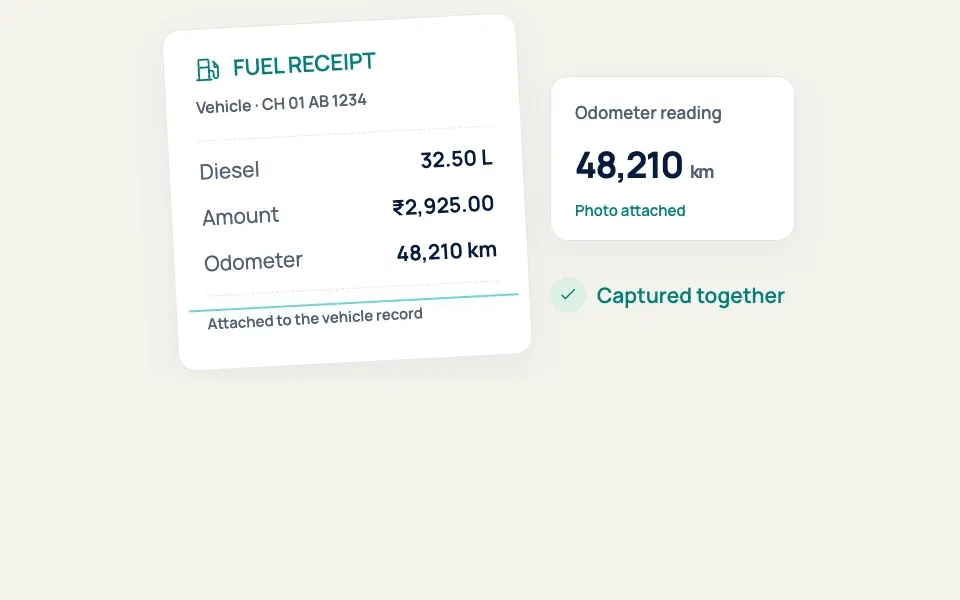
A receipt explains the purchase, not the whole journey
A fuel bill tells you what was bought, when and for how much. It does not explain the distance covered, the duty in progress or whether the entry belongs to the vehicle being reviewed. That context matters when a fleet team checks running costs.
Treat the receipt and the odometer reading as related records. Link them to the right vehicle and capture the relevant time and duty details. This gives the reviewer a useful sequence instead of asking them to reconstruct one from photos sent across different chats.
Agree on the few details that really matter
Keep the required entry small and consistent: vehicle, purchase date, fuel quantity, amount, receipt image and the relevant odometer reading. Add the payment or reimbursement context your business actually needs. If the receipt is unclear, ask for a new image while the driver still has it.
A photo should show the full bill without glare or fingers covering the figures. For the odometer, make sure the digits and unit can be read. Ask drivers to take these photos when safely stationary. Clear instructions are more useful than repeatedly rejecting submissions with no explanation.
Use extraction to assist the review
Image extraction can help bring visible figures into a record, but it is still worth checking the original image. Faded print, handwritten figures and unusual receipt layouts can all produce a reading that looks plausible while being wrong.
Give the reviewer an easy way to compare the extracted figures with the photo and explain any correction. CabNexus supports fuel-bill and odometer capture, with review workflows and configurable OCR processing. The useful outcome is a reviewed record, not simply a field filled in automatically.
Investigate the gap before drawing a conclusion
An unusual fuel entry is a reason to check the sequence. Look for a missing fill, a mistyped reading, a vehicle change or a duty that spans the reporting period. Compare like-for-like periods and consider the work being done, including city traffic, waiting time and route conditions.
Avoid treating one receipt as a reliable fuel-efficiency test. Partial fills and incomplete odometer histories can make a simple ratio misleading. First establish which purchases and readings belong together, then decide what the figures can reasonably tell you.
Close the review, then use the record
Every submitted bill should end in a clear state, such as accepted, needing clarification or rejected with a reason. Keep the original evidence and the explanation together so the next reviewer can understand the decision without repeating the investigation.
Once that routine is in place, monthly fuel checks become easier to prepare. Your team can work from a connected set of records instead of starting with a pile of receipts. That is a useful first step for any fleet trying to understand its running costs.